

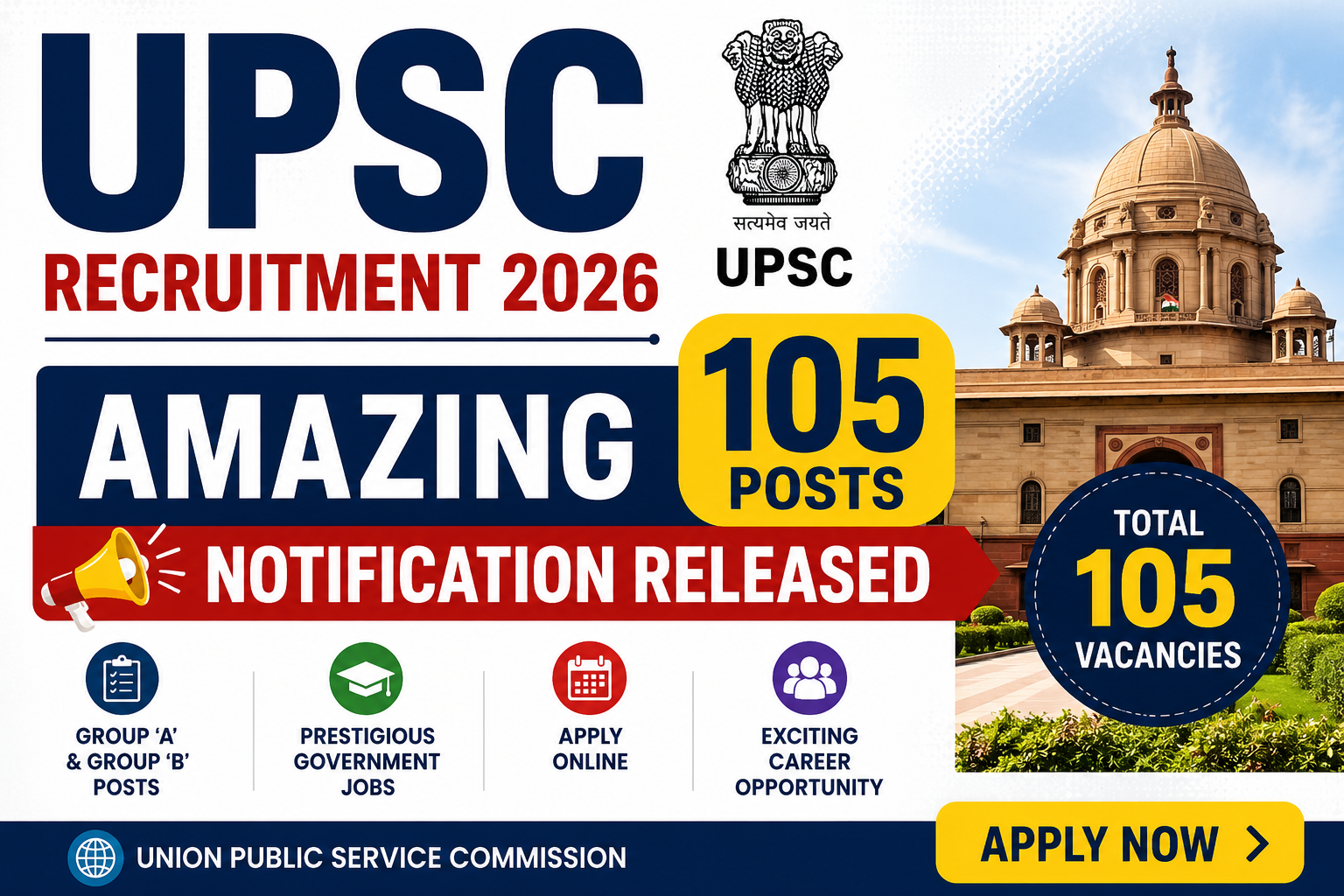
The Union Public Service Commission (UPSC) has officially released the Combined Defence Services Examination (CDS) I, 2026 notification under Examination Notice No. 4/2026. This prestigious examination is conducted for recruitment into the Indian Military Academy (IMA), Indian Naval Academy (INA), Air Force Academy (AFA), and Officers’ Training Academy (OTA), including SSC Women (Non-Technical) Course. Candidates aspiring to join the Indian Armed Forces as commissioned officers can apply online through the official UPSC portal.
CDS I 2026 Syllabus Overview
English
- Grammar, Vocabulary
- Comprehension
- Error spotting & sentence improvement
General Knowledge
- Current Affairs
- History of India
- Geography
- Indian Polity
- Economics
- General Science
Elementary Mathematics (10th level)
- Arithmetic
- Algebra
- Trigonometry
- Geometry
- Mensuration
- Statistics
Age Limit Rules for UPSC
Age Limit Rules for UPSC CDS I 2026: The age limit for UPSC CDS I 2026 is strictly defined by the Union Public Service Commission and varies according to the academy and course applied for. Candidates must ensure that their date of birth exactly matches the eligibility window mentioned in the notification. UPSC accepts only the date of birth mentioned in the Matriculation or Secondary School Certificate. Any mismatch or later request for correction is not permitted and may lead to cancellation of candidature at any stage of the selection process.
Age Limit for Indian Military Academy (IMA): For admission to the Indian Military Academy (IMA), Dehradun, only unmarried male candidates are eligible. Applicants must have been born not earlier than 2 January 2003 and not later than 1 January 2008. Candidates outside this age range will not be considered under any circumstances. Marriage during training is not permitted, and candidates must also meet all other eligibility conditions related to education and physical standards.
Age Limit for Indian Naval Academy (INA): Candidates applying for the Indian Naval Academy (INA), Ezhimala must also be unmarried male candidates. The prescribed age limit is the same as IMA, meaning applicants should be born between 2 January 2003 and 1 January 2008. Engineering qualification is mandatory for INA, but age eligibility is checked independently. Even a single day’s deviation from the notified date range makes the candidate ineligible for this course.
Age Limit for Air Force Academy (AFA): For the Air Force Academy (AFA), candidates must be aged 20 to 24 years as on 1 January 2027. This means they should be born between 2 January 2003 and 1 January 2007. Candidates holding a valid and current Commercial Pilot Licence (CPL) issued by DGCA, India, are eligible for age relaxation up to 26 years, allowing birth dates from 2 January 2001 onwards, subject to conditions.
Marital Status Rules for Air Force Candidates: Air Force Academy candidates below 25 years of age must be unmarried at the time of application. Marriage is strictly prohibited during the training period. Candidates aged 25 years or above may be married, but they will not be provided married accommodation and cannot live with family during training. Any candidate found violating marital status rules during training will be discharged and required to refund training expenses incurred by the Government.
Age Limit for Officers’ Training Academy (OTA) Men: For Officers’ Training Academy (OTA), Chennai – SSC (Men), only unmarried male candidates are eligible. The age criteria require candidates to be born not earlier than 2 January 2002 and not later than 1 January 2008. This slightly wider age range makes OTA a popular option among CDS aspirants. Male divorcees or widowers are not considered unmarried and are therefore not eligible for OTA entry.
Age Limit for Officers’ Training Academy (OTA) Women: For OTA Chennai – SSC Women (Non-Technical Course), eligible candidates include unmarried women, issueless widows who have not remarried, and issueless divorcees who have not remarried. The prescribed age limit is 2 January 2002 to 1 January 2008. Proper documentary proof is mandatory for widows and divorcees. Married women candidates are not eligible under this entry as per UPSC rules.
Proof of Date of Birth Accepted Documents: UPSC strictly accepts the Matriculation or Secondary School Examination Certificate as valid proof of age. No other documents such as birth certificates, affidavits, horoscopes, or municipal records are accepted. Candidates must ensure that the date of birth entered during One Time Registration (OTR) matches the certificate exactly. Any discrepancy discovered during verification will result in disciplinary action or cancellation of candidature.
Finality of Date of Birth Once Submitted: Once a candidate submits the application form with a specific date of birth, no change is allowed at any stage. UPSC clearly states that even clerical or typographical errors will not be corrected later. Candidates are advised to exercise extreme caution while filling the OTR profile and application form. Any attempt to alter the date of birth after submission is strictly rejected, regardless of supporting documents.
Key Age Limit Advice for CDS Aspirants: Candidates planning to apply for UPSC CDS I 2026 should verify their eligibility before applying, especially age limits and marital status conditions. Being eligible for one academy does not guarantee eligibility for others. Aspirants should align their preferences with their age eligibility to avoid rejection during selection or SSB stage. Meeting the age limit is the first and most crucial step toward a successful CDS application.
Educational Qualification Overview
Educational Qualification Overview for CDS I 2026: The UPSC CDS I 2026 educational qualification criteria vary depending on the defence academy selected by the candidate. Applicants must possess the required academic degree from a recognized university or institution approved by the Government of India. UPSC evaluates educational eligibility independently for each academy, and fulfilling the qualification for one course does not automatically make a candidate eligible for others. Candidates must carefully check degree requirements before selecting their service preferences during the application process to avoid rejection at later stages.
Educational Qualification for Indian Military Academy (IMA): To apply for the Indian Military Academy (IMA), Dehradun, candidates must hold a Bachelor’s Degree in any discipline from a recognized university or an equivalent qualification. There is no restriction on the subject or stream for graduation. Arts, Science, Commerce, and Professional degree holders are all eligible, provided the degree is awarded by a recognized institution. Final-year graduation students may also apply, subject to submission of proof of passing the degree before commencement of training.
Educational Qualification for Officers’ Training Academy (OTA): For admission to the Officers’ Training Academy (OTA), Chennai—both SSC Men and SSC Women (Non-Technical)—candidates must possess a Bachelor’s Degree from a recognized university. Similar to IMA, there is no stream restriction, making OTA a widely accessible option for graduates from all academic backgrounds. Candidates awaiting final results of their degree examinations can apply provisionally but must submit proof of qualification within the timeline prescribed by UPSC and Service Headquarters.
Educational Qualification for Indian Naval Academy (INA): Candidates applying for the Indian Naval Academy (INA), Ezhimala must hold a Degree in Engineering from a recognized university or institution. Only engineering graduates are eligible for INA, and degrees such as BE or BTech in approved branches are accepted. Candidates from non-engineering backgrounds are not eligible for INA, regardless of other qualifications. Final-year engineering students are allowed to apply, provided they can produce proof of passing the degree examination by the specified date.
Educational Qualification for Air Force Academy (AFA): For the Air Force Academy (AFA), candidates must possess a Bachelor’s Degree from a recognized university with Physics and Mathematics at the 10+2 level, or a Bachelor of Engineering degree. This requirement ensures technical and analytical readiness for Air Force training. Candidates who lack Physics or Mathematics at the intermediate level but hold an engineering degree are still eligible. Applicants must verify their academic background carefully before choosing AFA as their first preference.
Eligibility of Final-Year Students: UPSC allows final-year or final-semester students to apply for CDS I 2026 as a special concession. However, such candidates must submit a bonafide certificate from their college or university at the time of the SSB interview, confirming that they will complete the degree within the stipulated timeframe. Failure to produce proof of passing the degree examination by the required date will result in automatic cancellation of candidature, irrespective of performance in the written exam or SSB.
Submission of Degree Proof During SSB: Candidates shortlisted for the SSB Interview must carry original degree certificates or provisional certificates along with mark sheets of all semesters or years. Those who are appearing in the final year must carry official certification from their institution. Candidates failing to produce valid educational documents at the SSB centre will not be allowed to appear for the interview and will be sent back at their own expense. No relaxation is granted in this regard under any circumstances.
Recognition of Professional and Equivalent Degrees: Candidates holding professional or technical qualifications that are recognized by the Government as equivalent to a graduate degree are also eligible for CDS I 2026. UPSC reserves the right to evaluate whether a particular qualification meets the required academic standard. In exceptional cases, the Commission may treat a candidate as educationally qualified if their academic background is considered adequate, even if it does not strictly fall under conventional degree definitions.
Disqualification Related to Educational Criteria: Candidates who are debarred by the Ministry of Defence from holding any type of commission in the Defence Services are not eligible to apply, even if they meet the educational qualifications. Additionally, submission of false, incomplete, or fabricated educational documents can lead to permanent disqualification and legal action. UPSC conducts document verification thoroughly, and any discrepancy found at any stage will result in immediate cancellation of candidature.
Key Educational Qualification Advice for Applicants: Before applying for UPSC CDS I 2026, candidates should carefully align their educational background with their service preferences. Selecting an academy without meeting its academic criteria can lead to rejection during verification or SSB stages. Aspirants should keep all degree-related documents ready well in advance and ensure consistency between application details and certificates. Meeting the educational qualification criteria is essential for progressing smoothly through the CDS selection process.
Application Fee Overview for UPSC
Application Fee Overview for UPSC CDS I 2026: The application fee for UPSC CDS I 2026 is prescribed by the Union Public Service Commission and is mandatory for most candidates applying for the examination. The fee structure is simple and uniform, ensuring transparency in the application process. Candidates must pay the fee during the online application submission through the official UPSC portal. Applications submitted without successful fee payment, unless exempted, are considered incomplete and are rejected without further notice.
Application Fee Amount for General and OBC Candidates: All General category and OBC male candidates applying for CDS I 2026 are required to pay an application fee of ₹200 (Rupees Two Hundred only). This fee is applicable regardless of the number of academies or preferences selected by the candidate. Payment of the prescribed fee confirms the submission of the application and allows the candidate to proceed further in the examination process, including admit card generation.
Fee Exemption for Female Candidates: All female candidates applying for CDS I 2026 are fully exempted from paying the application fee. This exemption applies across all categories, including General, OBC, SC, and ST women candidates. Female applicants can complete the application process without making any payment, but they must still submit the online form correctly and within the specified deadline to be considered valid by UPSC.
Fee Exemption for SC and ST Candidates: Candidates belonging to Scheduled Caste (SC) and Scheduled Tribe (ST) categories are also exempted from paying the application fee. This exemption is granted automatically based on the category details entered in the application form. However, candidates must ensure that their category information is accurate, as any false claim regarding fee exemption can lead to rejection of the application or disqualification at later stages.
Accepted Modes of Application Fee Payment: The CDS I 2026 application fee can be paid online only through approved digital modes. Accepted payment methods include Debit Card, Credit Card, UPI, and Internet Banking. UPSC does not accept cash, demand draft, cheque, or any offline mode of payment. Candidates are advised to use secure payment options and complete the transaction well before the last date to avoid technical issues.
No Fee Refund Policy: UPSC clearly states that the application fee once paid will not be refunded under any circumstances. The fee also cannot be transferred or adjusted for any other examination conducted by UPSC. Even if a candidate withdraws from the examination, becomes ineligible later, or fails to appear for the exam, the paid fee will not be returned. Candidates must therefore verify eligibility before making payment.
Consequences of Incomplete or Failed Payment: Applications in which the fee payment is unsuccessful, incomplete, or not confirmed by the bank are treated as invalid for non-exempted candidates. UPSC may publish a list of such fictitious payment cases on its website and provide a limited window for submitting payment proof. Failure to resolve payment issues within the stipulated time will result in final rejection of the application.
Important Instructions for Fee Payment: Candidates must ensure that they receive a successful payment confirmation after completing the transaction. It is advisable to save or print the payment receipt for future reference. Any discrepancy in payment status should be addressed immediately through the UPSC helpdesk within the application window. Waiting until the last day for fee payment increases the risk of server errors and transaction failures.
Fee Details for OBC Candidates: Candidates belonging to the Other Backward Classes (OBC) category are not eligible for fee exemption and must pay the full application fee of ₹200. Many applicants mistakenly assume that OBC candidates are exempted, which is incorrect. OBC candidates must carefully check fee rules and complete the payment process properly to ensure their application is accepted by UPSC.
Key Application Fee Advice for CDS Aspirants: Before submitting the CDS I 2026 application, candidates should clearly understand whether they fall under the fee-paying or fee-exempt category. Paying the correct fee through the approved mode is essential for application acceptance. Candidates should avoid last-minute payments, verify transaction status, and keep records safely. Proper compliance with application fee rules helps prevent unnecessary rejection during the initial screening stage.
UPSC CDS I 2026 Important Dates
| Event | Date |
|---|---|
| CDS I 2026 Notification Release | 10 December 2025 |
| Online Application Start Date | 10 December 2025 |
| Last Date to Apply Online | 30 December 2025 (till 6:00 PM) |
| Last Date for Fee Payment | 30 December 2025 |
| Application Correction Window | Not Available |
| CDS I 2026 Admit Card Release | Last week of March 2026 |
| CDS I 2026 Written Examination Date | 12 April 2026 (Sunday) |
| CDS I 2026 Result Declaration (Written Exam) | May 2026 (Tentative) |
| SSB Interview Dates | August – December 2026 |
| Final Merit List Declaration | After SSB Completion |
| Course Commencement (IMA/INA/AFA) | January 2027 |
| Course Commencement (OTA) | April 2027 |
Syllabus & Exam Pattern UPSC
UPSC CDS I 2026 Exam Pattern Overview: The written examination for CDS I 2026 is conducted in offline (OMR-based) mode and consists of objective-type questions only. The exam pattern differs slightly for candidates applying to IMA, INA, and AFA compared to those applying for OTA. Each paper is conducted for 2 hours, and all questions carry equal marks. There is negative marking, where one-third of the marks allotted to a question are deducted for every wrong answer.
Exam Pattern for IMA, INA & AFA: Candidates applying for Indian Military Academy (IMA), Indian Naval Academy (INA), and Air Force Academy (AFA) must appear for three papers. These include English, General Knowledge, and Elementary Mathematics. Each paper carries 100 marks, making the total written examination marks 300. Candidates must qualify in all papers individually as well as in aggregate to be shortlisted for the SSB interview stage.
Exam Pattern for Officers Training Academy (OTA): For candidates applying to Officers’ Training Academy (OTA)—both SSC Men and SSC Women (Non-Technical) the written examination consists of two papers only. These are English and General Knowledge, each carrying 100 marks. The total written exam marks for OTA candidates are 200. Mathematics is not included for OTA, making it a preferred choice for candidates from non-mathematics backgrounds.
English Syllabus CDS I 2026: The English paper is designed to test a candidate’s understanding of the language and correct usage of words. The syllabus includes grammar, vocabulary, sentence improvement, error spotting, synonyms, antonyms, and comprehension passages. Candidates are expected to demonstrate clarity of expression and basic writing skills. The difficulty level is generally at the graduate standard, and regular reading practice significantly improves performance in this section.
General Knowledge Syllabus CDS I 2026: The General Knowledge (GK) paper covers a wide range of topics related to current events and general awareness. The syllabus includes History of India, Geography, Indian Polity, Economics, General Science, Defence-related topics, and Current Affairs. Questions are designed to test a candidate’s awareness of everyday observations and national and international developments. Consistent reading of newspapers and standard GK books is essential for scoring well.
Elementary Mathematics Syllabus CDS I 2026: The Elementary Mathematics paper is set at the matriculation (Class 10) level. The syllabus includes Arithmetic, Algebra, Trigonometry, Geometry, Mensuration, and Statistics. Key topics include number systems, percentages, profit and loss, quadratic equations, trigonometric identities, heights and distances, areas, volumes, and data interpretation. Strong conceptual clarity and regular practice are crucial, as this paper often becomes a deciding factor in merit ranking.
Marking Scheme and Negative Marking: Each correct answer in the CDS written examination carries one mark, while one-third (0.33 marks) are deducted for every incorrect response. If a candidate marks more than one option for a question, it is treated as a wrong answer and attracts negative marking. Questions left unanswered do not carry any penalty. Due to negative marking, candidates are advised to attempt questions carefully and avoid blind guessing.
Medium of Question Papers: The English paper is set exclusively in English. However, the General Knowledge and Elementary Mathematics papers are provided in both English and Hindi, allowing candidates to choose their preferred language. Candidates must ensure they understand the instructions clearly before attempting the paper. The bilingual nature of the papers makes the exam accessible to candidates from diverse educational backgrounds across India.
SSB Interview Pattern: Candidates who qualify the written examination are called for the Services Selection Board (SSB) Interview, which is conducted in two stages. Stage I includes the Officer Intelligence Rating (OIR) test and Picture Perception & Description Test (PPDT). Only candidates who clear Stage I proceed to Stage II, which includes Psychological Tests, Group Testing Officer (GTO) Tasks, Personal Interview, and Conference. The SSB process spans over 4–5 days.
Final Merit Calculation: The final merit list for CDS I 2026 is prepared based on the combined marks of the Written Examination and the SSB Interview. Candidates must secure the minimum qualifying marks separately in both stages. Final selection is subject to medical fitness, merit position, and availability of vacancies. Qualifying the written exam alone does not guarantee selection; consistent performance in the SSB is equally important for securing a place in the final merit list.
Selection Process UPSC CDS
Overview of CDS I 2026 Selection Process: The UPSC CDS I 2026 selection process is a multi-stage procedure designed to assess a candidate’s academic knowledge, personality, leadership qualities, and physical fitness. The recruitment process consists of a Written Examination, followed by the Services Selection Board (SSB) Interview, and finally a Medical Examination. Candidates must qualify at each stage independently to move forward. Final selection depends on overall merit, medical fitness, and availability of vacancies in the respective academies.
Stage One Written Examination: The first stage of the CDS I 2026 selection process is the written examination conducted by UPSC. This exam evaluates candidates on subjects such as English, General Knowledge, and Elementary Mathematics, depending on the academy applied for. The written exam is conducted in offline mode using OMR sheets and consists entirely of objective-type questions. Only candidates who secure the minimum qualifying marks set by UPSC are shortlisted for the next stage.
Academy-Wise Written Exam Qualification: Candidates applying for IMA, INA, and AFA must qualify in all three papers, whereas candidates applying for OTA (Men and Women) need to qualify in English and General Knowledge only. Clearing the written examination does not guarantee final selection; it only makes the candidate eligible for the SSB interview stage. Cut-off marks vary each year depending on exam difficulty and number of candidates appearing.
Shortlisting for SSB Interview: Based on written examination results, UPSC prepares a list of qualified candidates and forwards it to the respective Service Headquarters. Candidates are then allotted SSB interview dates and centers according to their preferences and merit. Candidates opting for Army as first choice must register on the Indian Army recruiting website to receive SSB call-up details. Failure to attend SSB on the given date may lead to cancellation of candidature.
Stage Two SSB Interview Process: The SSB Interview is the most crucial stage of the CDS selection process and focuses on evaluating Officer Like Qualities (OLQs). The SSB is conducted over 4 to 5 days and is divided into two stages: Stage I and Stage II. Only candidates who clear Stage I are allowed to proceed to Stage II. This stage tests psychological strength, decision-making ability, teamwork, leadership, and communication skills.
Stage I Screening Test: Stage I of the SSB includes the Officer Intelligence Rating (OIR) Test and the Picture Perception & Description Test (PPDT). This is a screening round, and a large number of candidates are eliminated at this stage. Performance in both OIR and PPDT determines whether a candidate moves to Stage II. Candidates who fail Stage I are sent back on the same day and are not assessed further.
Stage II Psychological Tests and GTO Tasks: Candidates who qualify Stage I undergo Stage II, which includes Psychological Tests, Group Testing Officer (GTO) Tasks, Personal Interview, and Conference. Psychological tests assess mental robustness and personality traits, while GTO tasks evaluate teamwork, leadership, and problem-solving skills through outdoor and indoor activities. The personal interview focuses on background, awareness, and motivation to join the Armed Forces.
Conference and Final Recommendation: The Conference is the final part of the SSB interview, where all assessors collectively review the candidate’s overall performance. Candidates may be asked brief questions before the final decision is made. Based on cumulative performance in all SSB tests, candidates are either Recommended or Not Recommended. Being recommended at SSB is mandatory to proceed to the medical examination stage.
Medical Examination Stage: Candidates recommended by the SSB must undergo a medical examination conducted by military medical authorities. The medical test ensures that candidates meet the prescribed physical and medical standards required for training in defence academies. Temporary or permanent medical unfitness can lead to rejection. In some cases, candidates are allowed to appeal or undergo review medical boards as per rules.
Final Merit List and Training Allotment: The final merit list for CDS I 2026 is prepared based on the combined marks of the Written Examination and SSB Interview. Candidates must qualify both stages separately. Final selection depends on merit rank, medical fitness, and vacancy availability in the preferred academy. Selected candidates are issued joining instructions for training at IMA, INA, AFA, or OTA, marking the beginning of their journey as officers in the Indian Armed Forces.
Important Documents Required UPSC
- Matriculation / Secondary School Examination Certificate (for Date of Birth proof)
- Bachelor’s Degree Certificate from a recognized university
- Provisional Degree Certificate (if final degree is not issued)
- All Semester / Year-wise Graduation Mark Sheets
- Final Year Bonafide Certificate (for candidates appearing in final year)
- Valid Photo Identity Proof (Aadhaar Card / Voter ID / PAN Card / Passport / Driving Licence)
- UPSC CDS I 2026 Admit Card (Written Examination & SSB)
- Recent Passport Size Photographs (same as application form)
- Caste Certificate for SC / ST / OBC candidates (if applicable)
- NCC ‘C’ Certificate (for candidates claiming NCC reservation, if applicable)
- SSB Call Letter / Interview Intimation Letter
- Medical Examination Reports (after SSB recommendation)
- Certificate of Eligibility (for candidates requiring nationality clearance)
- No Objection Certificate (NOC) for candidates serving in Government / Armed Forces

Sic bo, baby! Classic game, always a thrill. Sicbogames.com seems to have it dialed in. If you are a sic bo enjoyer be sure to visit: sic bo.