
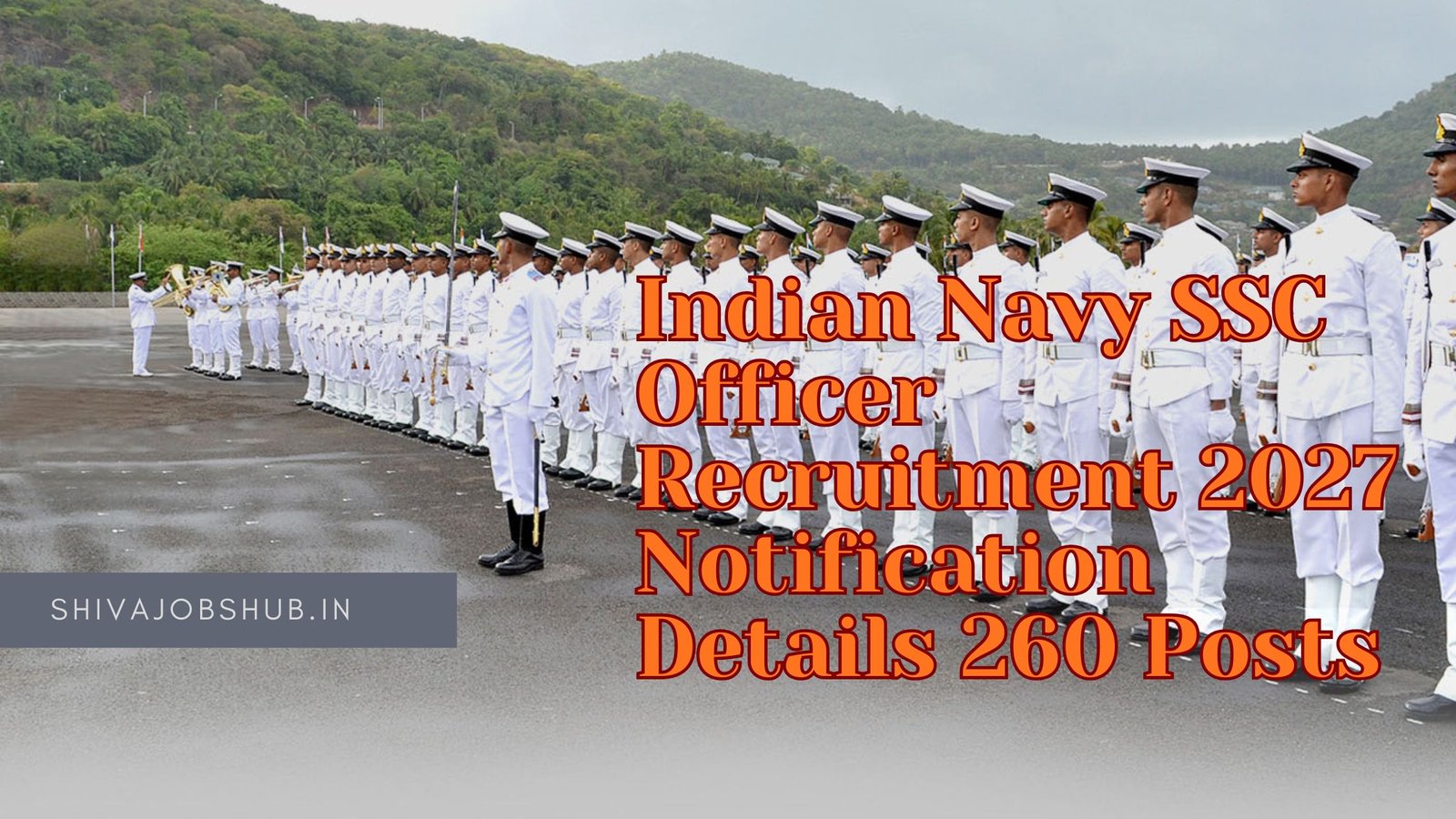
The Indian Navy has officially released the Short Service Commission (SSC) Officer Recruitment Notification for January 2027 (ST 27 Course). This recruitment drive invites unmarried men and women candidates to join the Indian Navy as officers in Executive, Technical, and Education branches. The course will commence in January 2027 at the Indian Naval Academy (INA), Ezhimala, Kerala.
Indian Navy SSC Officer 2027 Vacancy Details
- General Service (GS/X): 76 Posts
- Pilot: 25 Posts
- Naval Air Operations Officer (Observer): 20 Posts
- Air Traffic Controller (ATC): 18 Posts
- Logistics: 10 Posts
Gender: Men & Women
Age Limit for Indian Navy SSC Officer 2027 Overview
Age Limit for Indian Navy SSC Officer 2027 Overview: The Indian Navy has clearly defined the age eligibility criteria for candidates applying under the Short Service Commission (SSC) January 2027 course. Age limit plays a crucial role in determining eligibility, and candidates must strictly fall within the prescribed date of birth range for their respective branches. The age criteria vary depending on the entry such as Executive, Technical, Education, Pilot, or Submarine branch. Candidates must ensure that their date of birth matches exactly with the range mentioned in the official notification, as no relaxation is allowed beyond the specified limits. Applications of overage or underage candidates will be rejected at any stage of the selection process.
Age Limit for Executive Branch Candidates: For candidates applying under the Executive Branch including General Service (GS/X), Logistics, Naval Air Operations Officer, and Air Traffic Controller, the age limit has been fixed carefully by the Indian Navy. Applicants must be born between 02 January 2002 and 01 July 2007, both dates inclusive. This means candidates should be between approximately 19 to 25 years of age at the time of course commencement. The age criteria ensure that candidates are physically and mentally fit to undergo naval training and serve efficiently in demanding operational roles.
Age Limit for Pilot Entry: Candidates applying for the Pilot entry must strictly follow a separate age criterion. The eligible date of birth range for Pilot candidates is 02 January 2003 to 01 January 2008. This means candidates should not be younger than 18 years and not older than 24 years at the time of commencement of training. In addition to age eligibility, candidates must also fulfill vision standards and medical fitness requirements. Even if a candidate meets educational qualifications, failure to meet age criteria will result in rejection.
Age Limit for Naval Air Operations Officer (Observer): For the Naval Air Operations Officer (Observer) entry, the age criteria are similar to the Pilot branch. Candidates must be born between 02 January 2003 and 01 January 2008. This branch requires candidates who are young, physically fit, and capable of handling advanced aerial operations. The Indian Navy strictly verifies date of birth from Class 10 certificates or equivalent documents. Any mismatch in age details during document verification may lead to cancellation of candidature at any stage.
Age Limit for Education Branch: Candidates applying for the Education Branch must fall within the age range of 02 January 2000 to 01 January 2006. This branch allows slightly higher age limits compared to other entries due to the requirement of higher academic qualifications such as MSc, MTech, or MA. Candidates applying under this category must ensure they meet both age and educational criteria before submission of the application. The Indian Navy does not provide relaxation in upper age limit beyond the mentioned range.
Age Limit for Technical Branch (Engineering): For the Technical Branch including Engineering (GS), the eligible date of birth range is 02 January 2002 to 01 July 2007. Candidates applying under this branch must possess a valid engineering degree and must fall strictly within the prescribed age bracket. The age limit is designed to ensure that candidates are young enough to undergo rigorous naval training and long-term service. Any candidate falling outside this age limit will not be allowed to proceed further in the selection process.
Age Limit for Submarine Engineering Branch: The Submarine Engineering Branch has a separate age eligibility condition. Candidates applying for this entry must be born between 02 January 2002 and 01 July 2007. This branch is only open to male candidates due to operational requirements. Since submarine duties are highly specialized and physically demanding, the age limit is strictly enforced. Candidates must also clear additional medical standards specific to submarine service.
Age Limit for Electrical Branch: For the Electrical Branch under SSC, candidates must be born between 02 January 2002 and 01 July 2007. This entry is open to both male and female candidates. The age limit ensures that applicants have sufficient academic maturity and physical capability to serve in technical naval roles. Candidates must also ensure that their degree specialization matches the eligibility criteria mentioned in the notification, along with fulfilling the confirmed age requirement.
Age Relaxation Rules: The Indian Navy does not provide any relaxation in age limit for reserved categories such as SC, ST, OBC, or EWS for SSC Officer entries. The age eligibility is strictly calculated based on the date of birth mentioned in the Class 10 certificate. Candidates are advised not to rely on community-based relaxations, as these are not applicable in this recruitment. Even a one-day mismatch in date of birth can result in cancellation of candidature.
Important Instructions Regarding Age Eligibility: Candidates must ensure that their age falls within the prescribed limit on the date specified in the notification. The age verification is done during document verification and medical examination stages. Any discrepancy found later can lead to immediate disqualification, even after clearing SSB. Candidates should carefully verify their date of birth before applying and should not attempt to manipulate or misrepresent personal details, as this may lead to permanent debarment from future Navy recruitments.
Educational Qualification for Indian Navy SSC Officer 2027
Overview of Educational Qualification: The Indian Navy has prescribed specific educational qualifications for candidates applying to the SSC Officer Recruitment 2027. These qualifications vary depending on the branch such as Executive, Technical, Education, and Aviation branches. Candidates must possess the required degree from a recognized university or institution approved by the Government of India. It is mandatory that candidates complete their qualifying degree before joining the Indian Naval Academy in January 2027. Those who fail to meet the minimum educational standards will not be permitted to proceed further in the selection process, even if they clear the SSB interview.
Educational Qualification for Executive Branch: Candidates applying for the Executive Branch, including General Service (GS/X), are required to hold a BE or B.Tech degree in any discipline with a minimum of 60% aggregate marks. This branch is open to candidates from all engineering backgrounds, provided they meet the academic criteria. The Indian Navy considers marks obtained in all semesters while shortlisting candidates. Final year students are also eligible to apply, but they must submit proof of passing before joining the academy.
Educational Qualification for Pilot Entry: For the Pilot entry, candidates must possess a BE or B.Tech degree in any discipline with at least 60% marks. In addition to the degree requirement, candidates must have scored a minimum of 60% marks in both Class 10 and Class 12, with English as a compulsory subject in either class. Candidates holding a valid Commercial Pilot License (CPL) issued by DGCA India are also eligible to apply, provided they meet all academic and medical standards.
Educational Qualification for Naval Air Operations Officer: Candidates applying for the Naval Air Operations Officer (Observer) entry must have completed a BE or B.Tech degree with a minimum of 60% marks. There is no restriction on branch specialization for this entry, but candidates must have studied Physics and Mathematics during their academic career. The Indian Navy emphasizes academic consistency and performance, and candidates with strong technical backgrounds are preferred for this role.
Educational Qualification for Logistics Branch: For the Logistics Branch, candidates must possess any one of the following qualifications: BE/B.Tech with First Class, MBA with First Class, or B.Sc/B.Com/B.Sc (IT) with First Class along with a Post Graduate Diploma in Finance, Logistics, Supply Chain Management, or Material Management. Alternatively, candidates with MCA or M.Sc (IT) with First Class are also eligible. This branch focuses on administrative, financial, and logistics management responsibilities within the Navy.
Educational Qualification for Education Branch: The Education Branch requires candidates with strong academic backgrounds in science and engineering. Eligible qualifications include M.Sc or MA with minimum 60% marks in Mathematics, Physics, Operational Research, Meteorology, or Oceanography. Candidates with BE/B.Tech or M.Tech degrees in Mechanical, Electrical, Electronics, or Computer Science streams are also eligible. Additionally, candidates must have studied Physics or Mathematics at the graduation level to be considered eligible.
Educational Qualification for Technical Branch Engineering: For the Technical Branch (Engineering), candidates must hold a BE or B.Tech degree with minimum 60% marks in disciplines such as Mechanical, Marine, Aeronautical, Production, Automobile, Mechatronics, Instrumentation, or Industrial Engineering. The Indian Navy accepts degrees only from recognized universities or institutions approved by AICTE or UGC. This branch focuses on technical operations and maintenance of naval platforms.
Educational Qualification for Electrical Branch: Candidates applying for the Electrical Branch must possess a BE or B.Tech degree in Electrical, Electronics, Power Engineering, Instrumentation, or Communication Engineering with at least 60% marks. This branch plays a vital role in managing electrical systems onboard naval ships and submarines. Applicants must ensure that their specialization matches the eligibility list provided in the official notification.
Educational Qualification for Submarine Branch: The Submarine Branch requires candidates with BE/B.Tech degrees in Mechanical, Electrical, Electronics, or Control Engineering disciplines with a minimum of 60% marks. This branch is open only to male candidates due to operational requirements. Candidates must meet additional medical and physical standards due to the demanding nature of submarine service. Only those with strong academic and technical knowledge are considered suitable for this elite branch.
Important Notes on Educational Qualification: All candidates must ensure that their degree is completed before joining the Indian Naval Academy in January 2027. Final year students are allowed to apply, but they must submit proof of passing before the specified deadline. Degrees obtained from foreign universities must be recognized by the Government of India or approved by AIU. Any mismatch in educational details, incomplete qualification, or false information will lead to immediate disqualification at any stage of the recruitment process.
Important Dates Indian Navy SSC Officer Recruitment 2027
| Event | Date |
|---|---|
| Notification Release Date | January 2026 |
| Online Application Start Date | 24 January 2026 |
| Last Date to Apply Online | 24 February 2026 |
| Application Correction Window | Not Available |
| Shortlisting of Candidates | After Application Closing |
| SSB Interview Dates | March – June 2026 (Tentative) |
| Medical Examination | After SSB Selection |
| Final Merit List | December 2026 |
| Course Commencement | January 2027 |
| Training Location | Indian Naval Academy, Ezhimala |
Application Fee Details Indian Navy SSC Officer 2027
Overview of Application Fee: The Indian Navy SSC Officer Recruitment 2027 has been designed to be fully accessible to all eligible candidates across the country. To ensure equal opportunity, the Indian Navy has decided not to charge any application fee for this recruitment. Candidates from all categories can apply online without paying any registration or examination fee. This initiative encourages deserving candidates from all economic backgrounds to participate in the selection process without financial pressure.
Application Fee for General Category: Candidates belonging to the General category are not required to pay any fee while submitting the application form. Unlike many competitive examinations where fees range from ₹100 to ₹1000, the Indian Navy SSC recruitment is completely free. Applicants only need to complete the online registration process through the official website and upload the required documents without any payment gateway involvement.
Application Fee for OBC Candidates: Applicants belonging to the Other Backward Classes (OBC) category are also fully exempted from paying any application fee. The Indian Navy follows a transparent and equal opportunity recruitment policy, ensuring that financial status does not become a barrier for talented candidates. OBC candidates can apply online without worrying about application charges or transaction fees.
Application Fee for SC and ST Candidates: Candidates belonging to Scheduled Caste (SC) and Scheduled Tribe (ST) categories are completely exempted from paying any application or processing fee. The Indian Navy provides this exemption to promote inclusivity and ensure equal participation from all sections of society. SC and ST candidates only need to meet the eligibility criteria and submit valid category certificates during document verification.
Application Fee for Female Candidates: All female candidates, irrespective of their category, are exempted from paying any application fee for the Indian Navy SSC Officer Recruitment 2027. This step is taken to encourage more women to join the Indian Armed Forces and serve the nation in prestigious officer-level positions. Female applicants can complete the application process free of cost through the official website.
Mode of Application Fee Payment: Since there is no application fee, candidates are not required to make any online or offline payment. There is no debit card, credit card, UPI, or net banking transaction involved in the application process. Applicants must be cautious and avoid fake websites or agents claiming to collect fees on behalf of the Indian Navy.
No Refund Policy Applicable: As no fee is charged during the application process, the question of refund does not arise. Candidates who submit incorrect details or fail to meet eligibility conditions will not lose any money. However, once the application is submitted, it cannot be edited or withdrawn, so candidates must carefully verify all details before final submission.
Warning Against Fraud and Fake Agents: The Indian Navy has clearly stated that no person or agency is authorized to collect money for recruitment. Candidates should beware of fraud calls, messages, or websites asking for payment in exchange for selection or SSB calls. All official communication is done only through the Indian Navy website or registered email and mobile number of the candidate.
Importance of Applying Through Official Website: Candidates must apply only through the official website www.joinindiannavy.gov.in. Applications submitted through any other medium will not be accepted. Since the application process is free, candidates should avoid cyber cafés or agents who may charge unnecessary service fees. Applying directly ensures transparency and safety of personal information.
Final Instructions Regarding Application Fee: In conclusion, the Indian Navy SSC Officer Recruitment 2027 is completely free of cost for all applicants. No application fee, no examination fee, and no interview fee is required at any stage. Candidates are advised to keep proof of application submission and regularly check their registered email for updates. Applying early is recommended to avoid last-minute technical issues.
Exams & Syllabus Indian Navy SSC Officer 2027
Overview of Examination Process: The Indian Navy SSC Officer recruitment does not include a written examination like other competitive exams. Instead, candidates are shortlisted based on academic performance and then assessed through the SSB Interview process. The selection focuses on intelligence, personality, leadership skills, and officer-like qualities rather than rote learning. However, candidates must prepare thoroughly for the SSB as it includes psychological, reasoning, and personality-based evaluations that test mental strength, decision-making ability, and suitability for naval service.
Shortlisting Based on Academic Performance: The first step in the exam process is shortlisting based on normalized marks obtained in the qualifying degree. For BE/B.Tech candidates, marks up to the fifth or seventh semester are considered, depending on the course structure. For postgraduate candidates, all semester marks are evaluated. There is no written test conducted by the Indian Navy at this stage, but academic consistency plays a major role in receiving an SSB call letter.
SSB Interview – Stage I Examination: Stage I of the SSB Interview consists of Officer Intelligence Rating (OIR) Test and Picture Perception and Discussion Test (PPDT). The OIR test evaluates verbal and non-verbal reasoning ability, while PPDT assesses observation skills, imagination, and communication ability. Candidates must write a story based on a given picture and discuss it in a group. Only candidates who clear Stage I are allowed to appear for Stage II.
Psychological Tests Syllabus and Pattern: The psychological test is conducted on the second day of the SSB interview. It includes Thematic Apperception Test (TAT), Word Association Test (WAT), Situation Reaction Test (SRT), and Self Description Test (SDT). These tests evaluate mental stability, decision-making skills, social adaptability, emotional strength, and leadership qualities. There is no right or wrong answer, but honesty and presence of mind are extremely important.
Group Testing Officer (GTO) Tasks: The GTO tasks are conducted over two days and include Group Discussion, Group Planning Exercise, Progressive Group Task, Half Group Task, Individual Obstacles, Command Task, Lecturette, and Final Group Task. These activities assess teamwork, cooperation, leadership, confidence, and physical stamina. Candidates must actively participate without dominating or withdrawing from group activities.
Personal Interview: The personal interview is conducted by a senior officer and focuses on the candidate’s background, education, hobbies, achievements, general awareness, and motivation to join the Indian Navy. Questions may also be asked about academic subjects, current affairs, and situational judgment. The interview tests honesty, confidence, clarity of thought, and communication skills.
Medical Examination Standards: Candidates recommended by the SSB undergo a detailed medical examination at designated military hospitals. The medical test includes checks for eyesight, hearing, blood pressure, dental health, posture, BMI, and overall physical fitness. For flying and submarine branches, additional medical standards apply. Candidates declared unfit may apply for a review medical board within the prescribed time.
Final Merit List Preparation: The final merit list is prepared based on SSB marks only, subject to medical fitness and availability of vacancies. There is no written exam score involved in merit preparation. Even if a candidate clears SSB, final selection depends on rank in merit list and number of available vacancies in the chosen branch.
Training Syllabus at Indian Naval Academy: After selection, candidates undergo rigorous training at the Indian Naval Academy, Ezhimala. The training syllabus includes naval orientation, physical training, leadership development, academics, weapon training, swimming, drill, and outdoor exercises. The training aims to transform candidates into disciplined naval officers capable of handling operational responsibilities.
Preparation Tips for Exams and SSB: Candidates should focus on improving logical reasoning, communication skills, general awareness, and physical fitness. Reading newspapers, practicing mock SSB tests, participating in group discussions, and maintaining physical fitness are essential. Honesty, confidence, and presence of mind play a vital role in clearing the SSB. Regular self-assessment and disciplined preparation significantly increase selection chances.
Medical Standards Indian Navy SSC Officer 2027
Overview of Medical Standards: Medical fitness is one of the most important stages in the Indian Navy SSC Officer selection process. Candidates who clear the SSB interview must undergo a detailed medical examination conducted at authorized military hospitals. The medical standards are strictly followed to ensure that selected candidates are physically and mentally fit to serve in demanding naval conditions. Even a minor medical issue can lead to temporary or permanent disqualification if it affects operational efficiency.
General Medical Requirements: Candidates must be in good physical and mental health with no evidence of chronic illness or disability. The body should be well developed, and there should be no deformities that may interfere with military training or service. The Indian Navy checks overall fitness including posture, body structure, muscular strength, and endurance. Candidates must be free from diseases such as diabetes, asthma, heart problems, epilepsy, or any long-term medical condition.
Height and Weight Standards: Height and weight must be proportionate as per Indian Navy standards. Minimum height varies based on gender and branch, generally starting from 157 cm for males and 152 cm for females, with relaxations for certain regions. Weight should be in proportion to height and age according to Navy medical charts. Candidates who are overweight or underweight beyond permissible limits may be declared unfit.
Vision Standards: Vision standards are strictly enforced, especially for flying and submarine branches. For most entries, distant vision of 6/6 or 6/9 in the better eye and 6/9 or 6/12 in the other eye is required. Use of spectacles is allowed within prescribed limits for non-flying branches. For Pilot and Observer entries, unaided vision requirements are stricter and candidates must not have color blindness or night blindness.
Hearing and ENT Standards: Candidates must have normal hearing without any hearing loss. The ears should be free from infection, wax buildup, or perforation of the eardrum. Any chronic ENT condition such as sinusitis, deviated nasal septum causing obstruction, or repeated ear infections can lead to rejection. Hearing ability is tested carefully as it is crucial for communication in naval operations.
Dental and Oral Health Standards: Dental health plays an important role in medical selection. Candidates must have a sufficient number of healthy teeth with good dental hygiene. Severe dental caries, missing teeth affecting chewing ability, or gum diseases may lead to disqualification. Candidates are advised to complete any dental treatment well before appearing for the medical examination to avoid rejection.
Medical Standards for Submarine Branch: Submarine candidates are subjected to more stringent medical standards due to the challenging underwater environment. Candidates must have excellent cardiovascular health, normal lung function, and strong psychological stability. Any history of claustrophobia, respiratory illness, or ear problems is considered disqualifying. Only candidates with exceptional medical fitness are selected for submarine duties.
Medical Standards for Pilot and Observer: Candidates applying for Pilot and Naval Air Operations Officer roles must meet higher medical standards. Vision requirements are stricter, including limits on refractive error. Candidates must not have color blindness, night blindness, or any eye disorder. Height, leg length, and sitting height must fall within specified limits to safely operate aircraft. Any previous eye surgery is usually not permitted.
Review Medical Board and Appeals: Candidates declared temporarily unfit are allowed to appeal for a Review Medical Board within the specified time. The review is conducted at a designated military hospital, and the decision of the board is final. However, candidates found permanently unfit for a particular branch will not be allowed to reappear for medical examination for the same entry.
Final Medical Fitness Guidelines: Candidates must ensure that they are medically fit before appearing for SSB to avoid disappointment later. Maintaining physical fitness, proper diet, regular exercise, and medical checkups before the examination can improve chances of selection. Any concealment of medical history or submission of false information can lead to permanent disqualification from Indian Navy recruitment.
Selection Process Indian Navy SSC Officer 2027
Overview of Selection Process: The selection process for Indian Navy SSC Officer Recruitment 2027 is designed to identify capable, disciplined, and mentally strong candidates for officer-level responsibilities. The entire process is conducted in multiple stages, starting from shortlisting of applications to final medical examination and merit list preparation. Only candidates who clear all stages successfully will be offered training at the Indian Naval Academy. The selection process is transparent and purely merit-based, ensuring fairness to all applicants.
Shortlisting of Applications: The first stage of selection is shortlisting based on academic performance. Candidates are shortlisted using normalized marks obtained in the qualifying degree. For BE/B.Tech candidates, marks up to the fifth or seventh semester are considered depending on the course structure. For postgraduate candidates, marks of all semesters are taken into account. Higher academic performance increases the chances of getting shortlisted for the next stage.
Intimation for SSB Interview: Candidates who are shortlisted will receive an intimation for the SSB Interview through their registered email ID and mobile number. The call-up letter will contain details regarding the SSB center, reporting date, and instructions to be followed. Candidates must download the call letter and carry it to the SSB center. No separate postal communication will be sent, so candidates must regularly check their email.
Stage I of SSB Interview: The first stage of the SSB Interview is known as Screening Test, which includes an Officer Intelligence Rating (OIR) test and Picture Perception & Discussion Test (PPDT). This stage evaluates the candidate’s logical thinking, observation skills, communication ability, and leadership qualities. Candidates who fail in Stage I are sent back on the same day, while those who qualify move to Stage II.
Stage II of SSB Interview: Stage II of the SSB Interview is conducted over four to five days and includes Psychological Tests, Group Testing Officer (GTO) tasks, and Personal Interview. These tests assess personality traits such as confidence, decision-making ability, teamwork, leadership, and emotional stability. The performance of the candidate across all these tests plays a crucial role in final selection.
Medical Examination: Candidates recommended by the SSB board must undergo a detailed medical examination at designated military hospitals. Medical standards for the Indian Navy are very strict, especially for vision, hearing, height, weight, and overall physical fitness. Candidates declared medically unfit may be given a chance for review medical examination, but final fitness is mandatory for selection.
Preparation of Final Merit List: After successful completion of the SSB interview and medical examination, a final merit list is prepared. The merit list is based solely on SSB marks and availability of vacancies in each branch. Being recommended by SSB does not guarantee final selection unless the candidate’s name appears in the merit list.
Joining Instructions and Document Verification: Candidates selected in the merit list will receive joining instructions from the Indian Navy. They must submit all original documents such as educational certificates, age proof, identity proof, and medical fitness certificates. Any mismatch or false information found during verification will lead to cancellation of candidature even at this stage.
Training at Indian Naval Academy: Selected candidates will undergo training at the Indian Naval Academy (INA), Ezhimala, Kerala. During training, candidates are appointed as Sub Lieutenants and undergo rigorous physical, academic, and military training. Only unmarried candidates are allowed to join the training, and marriage during training leads to disqualification.
Final Appointment and Commission: After successful completion of training, candidates are granted Short Service Commission in the Indian Navy. The initial commission period is 12 years, which may be extended up to 14 years based on performance and service requirements. Officers are posted in various naval units across India and abroad, serving the nation with honor and pride.
Important Documents Indian Navy SSC Officer 2027
- Class 10 Certificate (Date of Birth Proof)
- Class 12 Mark Sheet & Certificate
- Degree / Provisional Certificate
- All Semester Mark Sheets
- Final Year Bonafide Certificate (if applicable)
- Aadhaar Card / Voter ID / Passport
- Recent Passport Size Photographs
- NCC ‘C’ Certificate (if applicable)
- Caste Certificate (SC/ST/OBC/EWS – if applicable)
- Medical Fitness Certificate
- SSB Call Letter Printout
- Domicile Certificate (if required)
- Passport (if available)



1 thought on “Indian Navy SSC Officer Recruitment 2027 Notification Details 260 Posts”