
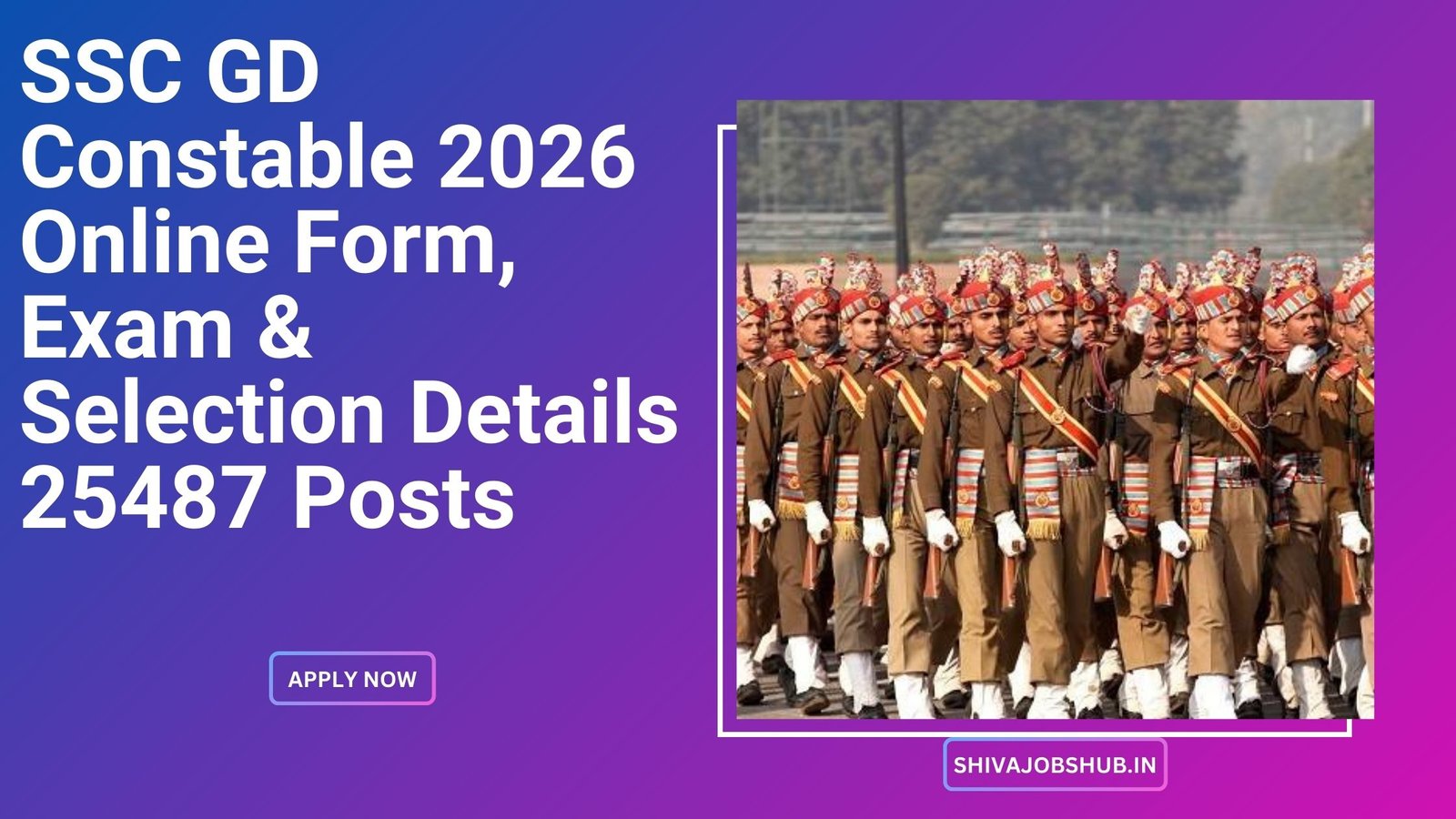
The Staff Selection Commission (SSC) has officially released the Constable (GD) Recruitment Notification 2026 for positions in CAPFs, SSF, and Rifleman (GD) in Assam Rifles. This national-level recruitment drive aims to select thousands of young candidates for General Duty Constable roles across India. The selection process includes a Computer-Based Exam (CBE), Physical Standards Test (PST), Physical Efficiency Test (PET), Medical Exam, and Document Verification.
Vacancy Details Force-Wise:
According to the official notification, SSC opened 25,487 total vacancies, with detailed breakup across forces such as BSF, CISF, CRPF, ITBP, SSB, Assam Rifles, and SSF. Vacancies are also divided state-wise and category-wise. SSC GD Constable 2026
- BSF: 616 posts
- CISF: 14,595 posts
- CRPF: 5,490 posts
- SSB: 1,764 posts
- ITBP: 1,293 posts
- Assam Rifles: 1,706 posts
- SSF: 23 posts
Age Limit as per SSC Guidelines:
Official Age Limit as per SSC Guidelines: The SSC GD Constable 2026 notification clearly states that applicants must fall within the age bracket of 18 to 23 years as of 01 January 2026. This means candidates must be born between 02 January 2003 and 01 January 2008. Anyone outside this date range becomes automatically ineligible. The Commission strictly follows DoPT rules for calculating age, ensuring transparency and uniformity across all categories. SSC GD Constable 2026
Age Calculation Based on Crucial Date: The age of the applicant is evaluated solely on the “crucial date,” which for this recruitment is 01-01-2026. Even a single day beyond the permitted range leads to disqualification. This rule eliminates ambiguity while checking age certificates during document verification. SSC does not consider later corrections or changes in the date of birth after submitting the application form.
Age Relaxation for SC and ST Candidates: Candidates belonging to Scheduled Castes (SC) and Scheduled Tribes (ST) receive a significant relaxation of 5 years in the upper age limit. This allows SC/ST applicants to apply until the age of 28 years. The relaxation is provided under government reservation policies to ensure representation of communities facing historical disadvantages.
OBC Category Age Relaxation: Applicants under the Other Backward Classes (OBC) category get an upper-age relaxation of 3 years, allowing them to apply up to 26 years of age. This benefit applies only if the candidate belongs to the Non-Creamy Layer (NCL) and holds a valid OBC certificate issued within the regulatory timeframe. Creamy Layer candidates cannot claim OBC relaxation.
Age Benefits for Ex-Servicemen: Ex-Servicemen are allowed 3 years of relaxation beyond the upper age limit after deducting military service duration from their actual age. For example, a candidate who served 4 years in the Armed Forces will get age relaxation based on the formula provided by the SSC. This ensures smooth transition of trained defence personnel into CAPF and allied forces.
Age Relaxation for Children of 1984 Riot Victims (UR/EWS): SSC provides 5 years of age relaxation for unreserved (UR) and EWS category candidates who are children or dependents of individuals killed in the 1984 riots. This is a welfare measure designed to support families affected by the tragic incident. Applicants must present valid certificates issued by district authorities to avail this relaxation.
OBC Candidates Among Riot Victim Families: If the applicant belongs to the OBC category and is also a dependent of a 1984 riot victim, they receive a total relaxation of 8 years on the upper age limit. This increases eligibility up to 31 years, provided valid proof is submitted. The dual relaxation acknowledges both caste-based reservation benefits and riot-victim support provisions.
SC/ST Children of Riot Victims: SC and ST candidates who are children or dependents of persons killed in the 1984 riots get the highest relaxation of 10 years, allowing them to apply up to 33 years. This extended age benefit is intended to support individuals who face compounded historical and social disadvantages, ensuring they are not excluded due to age restrictions.
No Age Benefits for Dependents of Ex-Servicemen: One important rule often overlooked is that sons, daughters, and dependents of ex-servicemen do NOT receive any age relaxation. The relaxation is available only for the ex-servicemen themselves. Therefore, dependents should apply strictly within the general age limit unless they belong to another eligible reserved category such as SC, ST, OBC, or EWS.
Importance of Accurate DOB and Certificate Verification: The date of birth mentioned in the Matriculation/10th Certificate is the only accepted proof for age verification. SSC does not allow modifications after the application is submitted, and mismatches can lead to instant cancellation. Candidates must ensure their DOB, certificate validity, and category claims are accurate to enjoy age relaxation benefits without complications.
Minimum Required Qualification for SSC GD:
Minimum Required Qualification for SSC GD 2026: To apply for the SSC GD Constable 2026 recruitment, candidates must have passed the Matriculation or 10th Standard examination from a recognized board. This is the fundamental eligibility criterion without which no candidate can participate in the recruitment process. The certificate must be issued by a government-recognized educational board such as CBSE, ICSE, or any state board.
Qualification Must Be Completed Before Cut-Off Date: The educational requirement must be fulfilled on or before 01 January 2026, which is the official cut-off date mentioned in the notification. Candidates awaiting results or appearing for the 10th exam after this date are not eligible. SSC strictly checks the date of issuance of the marksheet or pass certificate during Document Verification.
Recognition of Boards and Institutions: Only qualifications obtained from recognized schools and boards will be accepted. The board must be authorized by the central or state government. If a candidate’s marksheet is from an unrecognized institution, the application will be rejected during verification. Therefore, candidates must ensure that their schooling meets all approval standards.
Open School and Distance Learning Validity: SSC recognizes 10th Class certificates obtained through Open School systems such as NIOS or State Open Schools, provided they are approved by the government. Distance learning and open schooling certificates are fully valid as long as the institution is recognized. Candidates must keep proof of recognition handy during document checks.
Certificates Obtained Through Distance Mode: As per government guidelines, distance-mode certificates are considered valid for employment if the institution is approved by the Distance Education Bureau (DEB) of the UGC. Candidates with such certificates must produce supporting documents verifying recognition for the year in which the qualification was awarded.
No Higher Qualification Requirement: Unlike many competitive exams, SSC GD does not demand higher educational qualifications such as Intermediate or Graduation. 10th pass is sufficient for all posts under CAPFs, SSF, and Assam Rifles. Candidates possessing higher qualifications can also apply, but no extra preference or bonus marks are awarded for higher studies.
Importance of Original Documents during Verification: Candidates shortlisted for Medical Examination and Document Verification must present original educational certificates, including marksheets and pass certificates. SSC does not accept provisional documents unless they are officially issued and contain the required authentication. Any mismatch may result in cancellation of candidature.
Proof of Result Declaration Date: Candidates whose results were declared on or before the cut-off date are eligible, even if the certificate was issued later. However, they must provide valid proof—such as an official board notice or authenticated marksheet—to show that the result was published before 01-01-2026. Only processing of result is not enough; it must be officially declared.
Importance of Consistent Personal Details: The name, father’s name, and date of birth mentioned in the educational certificates should match the details filled in the online application. Discrepancies can lead to rejection. SSC uses matriculation certificates as the primary identity and age-proof document, so consistency is crucial for smooth verification.
NCC Certificate Bonus Marks Not Linked to Education: Although not an educational condition, candidates with NCC A, B, or C certificates are awarded bonus marks in the written exam. However, this is not part of the academic qualification requirement. SSC grants these additional marks only if the NCC certificate is valid and issued on or before 01-01-2026, and produced during verification.
Standard Application Fee for SSC GD:
Standard Application Fee for SSC GD 2026: The Staff Selection Commission has fixed a standard application fee of ₹100 for all candidates applying under the General, OBC, and EWS categories. This fee must be paid during the online form submission process. Without successful payment, the application will be marked as incomplete and rejected. The fee ensures participation in the Computer-Based Examination stage.
Fee Exemption for Reserved Categories: SSC provides a full fee exemption for candidates belonging to Scheduled Castes (SC), Scheduled Tribes (ST), and all Women applicants. Ex-Servicemen eligible for reservation are also exempted from the payment of the fee. This exemption supports equal access and encourages participation from marginalized and economically weaker sections.
Accepted Online Payment Modes: The Commission accepts payments strictly through online modes only, such as BHIM UPI, Net Banking, Visa, MasterCard, Maestro, and RuPay Debit Cards. No other modes such as offline challans, demand drafts, or cash payments are accepted. Candidates must ensure stable internet connectivity while completing transactions to avoid payment failure.
Last Date for Fee Payment: The last date for making the online fee payment is clearly mentioned as 01 January 2026 till 11:00 PM. Any payment attempted after this deadline will not be processed, and the application will be considered invalid. SSC advises candidates to pay early instead of waiting for the deadline, as heavy traffic on closing days may cause payment issues.
Fee Status Verification Process: Candidates can verify their fee payment status through the Payment Status option in their SSC login dashboard. If the status shows “Incomplete,” it means the payment was not received by SSC. Only applications showing “Successfully Paid” will be accepted. Candidates should keep screenshots or digital receipts as backup proof. SSC GD Constable 2026
No Refund Policy for Application Fee: SSC strictly follows a no-refund policy, meaning that once the fee is paid, it cannot be refunded under any circumstances. Even if a candidate makes multiple payments, submits incorrect details, or later withdraws their application, the amount will not be returned. The fee cannot be adjusted for future SSC exams either. SSC GD Constable 2026
Fee Requirement for Correction Window: If candidates wish to make corrections during the provided correction window, they must pay a correction charge instead of an application fee. The first correction submission costs ₹200, while the second correction attempt requires ₹500. These charges are compulsory and non-refundable, regardless of the type or extent of correction. SSC GD Constable 2026
Fee Exemption Conditions for Ex-Servicemen: While Ex-Servicemen are exempt from paying the application fee, this exemption applies only to those who have not previously used the reservation benefit for civil employment. If they have already secured a job based on ESM reservation and did not declare the same as per rules, they must pay the application fee and will not receive ESM fee benefits.
Consequences of Unsuccessful Fee Payment: If the fee fails to reach SSC due to transaction errors or network failures, the application remains incomplete, regardless of whether money is deducted from the candidate’s bank. Candidates must contact their bank for refunds and retry payment before the deadline. SSC will not entertain requests for manual verification or late acceptance. SSC GD Constable 2026
Importance of Early Fee Submission: SSC strongly advises candidates to complete fee payment well before the final date. Delayed attempts on the last day may lead to server congestion, payment gateway failures, or session timeouts. Early submission ensures smoother processing of the application and gives candidates time to rectify any issues without missing the deadline.
SSC GD Constable 2026 Important Dates:
| Event | Date |
|---|---|
| Release of Official Notification | 01 December 2025 |
| Start of Online Application | 01 December 2025 |
| Last Date to Submit Application Form | 31 December 2025 (11:00 PM) |
| Last Date for Online Fee Payment | 01 January 2026 (11:00 PM) |
| Application Correction Window | 08 January 2026 to 10 January 2026 (11:00 PM) |
| Computer-Based Examination (CBE) | February – April 2026 (Tentative) |
| Release of CBT Admit Card | 3–7 days before exam date |
| Admit Card for PET / PST | Issued by CRPF about 2 weeks before test |
| PET / PST Schedule | After CBT Result (Dates to be announced) |
| Medical Examination (DME/RME) | After PET/PST (Scheduled by CAPFs) |
SSC GD Examination Structure:
Overview of SSC GD Examination Structure: The SSC GD Constable 2026 examination is conducted in multiple stages beginning with a Computer-Based Examination (CBE) followed by Physical Efficiency Test (PET), Physical Standards Test (PST), Medical Examination, and Document Verification. The CBE is the primary screening stage, determining whether candidates move forward to the physical tests. Each stage is important and contributes to the final merit, making preparation essential. SSC GD Constable 2026
Computer-Based Examination Pattern: The CBE consists of 80 multiple-choice questions carrying a total of 160 marks, with each question worth 2 marks. The duration of the exam is 60 minutes, and the paper is divided into four equal sections—Reasoning, General Knowledge, Mathematics, and English/Hindi. The exam is conducted in English, Hindi, and 13 regional languages, offering wide accessibility to candidates across India. SSC GD Constable 2026 SSC GD Constable 2026
Negative Marking and Normalization: The exam includes a negative marking of 0.25 marks for each wrong answer, so candidates must attempt questions carefully. After the exam, SSC applies a normalization method to ensure fairness across different shifts. The normalized score becomes the basis for shortlisting candidates for PET/PST. Bonus marks for NCC certificate holders are also added during merit preparation. SSC GD Constable 2026
General Intelligence & Reasoning Syllabus: This section evaluates the candidate’s analytical and logical thinking abilities. Questions may include analogies, coding-decoding, series, relationships, visual memory, figure classification, spatial reasoning, and non-verbal reasoning. The aim is to test how quickly and accurately candidates can recognize patterns, solve logic-based problems, and process information. SSC GD Constable 2026
General Knowledge & Awareness Syllabus: The GK section covers questions related to current affairs, national and international events, Indian history, geography, economy, constitution, scientific research, sports, and neighboring countries. Candidates must stay updated with recent happenings as many questions come from trending news and government schemes. Basic understanding of daily events is essential for scoring well. SSC GD Constable 2026
Elementary Mathematics Syllabus: The Mathematics section includes basic arithmetic and number-based concepts such as Number Systems, Decimals, Fractions, Percentages, Ratios, Time & Distance, Averages, Simple Interest, Profit & Loss, Discounts, Mensuration, and Time & Work. Candidates with strong fundamentals in school-level math generally perform well in this part of the exam. SSC GD Constable 2026
English/Hindi Language Syllabus: The language section measures reading comprehension and grammar skills. Questions include basic grammar rules, fill-in-the-blanks, antonyms, synonyms, error spotting, sentence structure, vocabulary usage, and simple comprehension passages. Candidates can choose either English or Hindi, based on their comfort level, as both carry equal importance in scoring. SSC GD Constable 2026
Physical Efficiency Test (PET) Requirements: Candidates shortlisted from the CBE must undergo PET, which tests physical strength and stamina. Male candidates must complete a 5 km run in 24 minutes, while female candidates must finish a 1.6 km run in 8½ minutes. For Ladakh region candidates, the distance is reduced. Performance in PET is qualifying in nature, meaning no marks are awarded but passing is mandatory.
Physical Standards Test (PST) Criteria: PST evaluates physical measurements such as height, chest (for males), and weight. Standard height is 170 cm for males and 157 cm for females, with relaxations for specific categories like ST, Hill regions, and North-Eastern states. Chest expansion of 5 cm is required for male candidates. Failing PST leads to direct rejection regardless of exam marks. SSC GD Constable 2026
Medical Examination and Final Merit: Candidates who clear PET and PST undergo a detailed medical examination to ensure physical fitness for duty. Medical boards check vision, hearing, physical deformities, and overall health. After this stage, Document Verification is conducted to confirm eligibility. Final merit is prepared based on normalized CBE scores plus NCC bonus marks, and force allocation is completed based on preferences and rank. SSC GD Constable 2026
SSC GD Constable 2026 Selection Process:
Multi-Stage Recruitment Structure: The SSC GD Constable 2026 selection process is conducted in multiple stages, beginning with a Computer-Based Examination (CBE) followed by the Physical Efficiency Test (PET), Physical Standards Test (PST), Medical Examination, and finally Document Verification. Each stage serves a unique purpose in assessing the candidate’s cognitive ability, physical fitness, and eligibility. Only those who qualify every stage are included in the final merit list. SSC GD Constable 2026
Computer-Based Examination as First Filter: The CBE is the first and most important stage of the recruitment process. It consists of 80 objective-type questions carrying 160 marks, spread across four subjects. The exam is conducted in multiple languages and includes negative marking. Candidates scoring the minimum qualifying marks—30% for UR, 25% for OBC/EWS, and 20% for others—are shortlisted for PET/PST. The CBE score forms the basis for the final merit calculation. SSC GD Constable 2026
Normalization and NCC Bonus Marks: SSC uses a normalization method to ensure fairness among candidates appearing in different shifts. After normalization, NCC certificate holders receive additional bonus marks depending on their certificate category A, B, or C. These bonus marks are added only if candidates provide valid NCC certificates during verification, ensuring transparency in the merit calculation.
Shortlisting for Physical Tests: Based on performance in the CBE, SSC shortlists candidates for the next stage in a ratio of about 8 times the number of vacancies. This shortlisting is done state-wise, gender-wise, and category-wise, ensuring fair distribution of opportunities. Candidates must download their PET/PST admit card from CRPF’s official website and appear at the assigned center along with required identification documents. SSC GD Constable 2026
Physical Efficiency Test (PET) Requirements: The PET evaluates stamina and endurance through timed running tasks. Male candidates must complete a 5 km run in 24 minutes, while female candidates must run 1.6 km in 8½ minutes. For Ladakh region candidates, the running distance is shorter. PET is a qualifying stage—no marks are awarded, but candidates must pass to proceed further in the recruitment cycle.
Physical Standards Test (PST) Assessment: Candidates who clear PET must undergo PST, which assesses height, chest measurements (for males), and weight. Standard parameters are fixed for all, with relaxations for categories like SC/ST, Kumaonis, Gorkhas, and candidates from the North-East. Chest expansion of at least 5 cm is mandatory for male candidates. Any failure in PST leads to immediate disqualification.
Appeal Option for PST Rejection: Candidates who are found unfit during the height or chest measurement in PST can submit an appeal on the same day. This appeal is reviewed by an appellate authority present at the center. If the second evaluation confirms eligibility, the candidate is allowed to continue. However, there is no appeal allowed for the PET race, making it crucial to perform well in the first attempt.
Detailed Medical Examination (DME): After qualifying PET and PST, candidates undergo a Detailed Medical Examination, where CAPF medical boards assess vision, physical health, past medical history, and any physical deformities. This stage ensures that selected candidates are medically fit to perform duties in challenging environments. Candidates failing DME may apply for a Review Medical Examination (RME) under specific conditions. SSC GD Constable 2026
Document Verification Procedure: During DME or after RME, candidates must present original documents, including 10th certificate, domicile proof, category certificate, ESM/NCC certificates, and other required documents. Any mismatch or false information leads to cancellation of candidature. Verification ensures that only genuinely eligible candidates progress to the final merit list. SSC GD Constable 2026
Final Merit List and Force Allocation: The final merit list is prepared based on normalized CBE marks plus NCC bonus marks, if applicable. PET, PST, and medical exams are qualifying, so they do not contribute to marks. SSC prepares merit lists state-wise, category-wise, and gender-wise. Selected candidates are then allotted to forces such as BSF, CISF, CRPF, SSB, ITBP, Assam Rifles, and SSF according to their merit rank and preference order submitted during application.
SSC GD Constable 2026 Important Documents List:
- 10th Class Certificate (Matriculation Certificate) Proof of Date of Birth & Education
- 10th Class Marksheet Must show passing status and subjects
- Valid Photo ID Proof Aadhaar / PAN / Voter ID / Passport / Driving License
- Domicile Certificate / Permanent Resident Certificate (PRC) Mandatory for state-wise posts
- SC / ST / OBC / EWS Category Certificate As per SSC prescribed format
- OBC Non-Creamy Layer Certificate For those applying under OBC reservation
- EWS Income & Asset Certificate (2025–26) For EWS applicants
- NCC Certificate (A/B/C) For candidates claiming NCC bonus marks
- Ex-Servicemen Documents Discharge Book, Undertaking, and Service Certificate
- Certificate for Height/Chest Relaxation For hill areas, NE states, Gorkhas, SC/ST, etc.
- Certificate for 1984 Riot Victims Provided by District Magistrate/Collector
- Passport-Size Photographs Recent color photos matching online form
- Aadhaar Authentication Record (if used) Only Aadhaar card required at center
- Residential or Address Proof If asked during verification
- Any Additional Documents related to sports, name changes, or legal certificates If applicable




1 thought on “SSC GD Constable 2026 Online Form Exam & Selection Details 25487 Posts”