
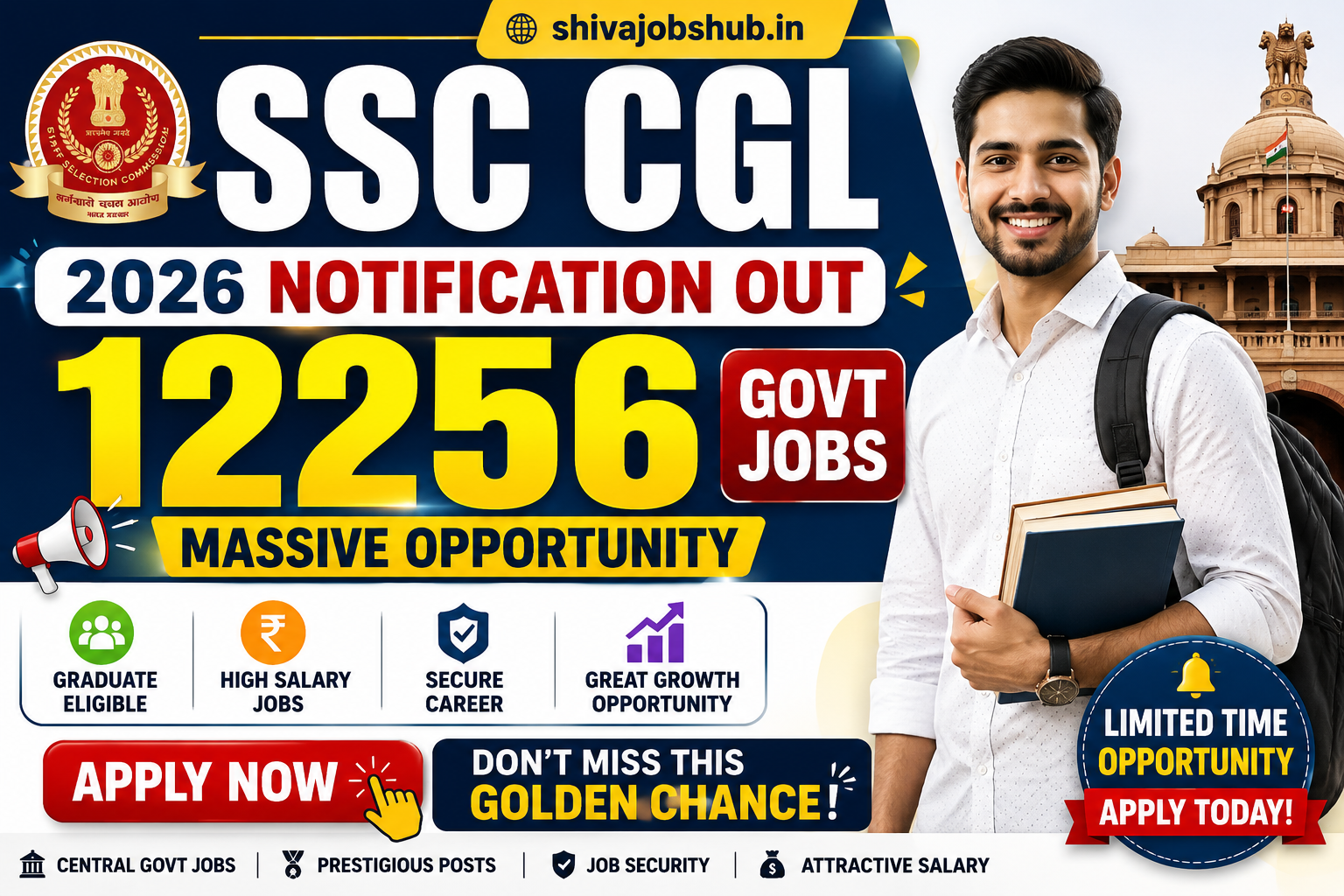
SSC CGL is one of the most popular government exams in India because it offers excellent salary packages, job security, promotions, and opportunities to work in prestigious departments like Income Tax, CBI, Customs, Ministry of External Affairs, and more.
SSC CGL 2026 Vacancy Details
- Assistant Audit Officer
- Assistant Accounts Officer
- Assistant Section Officer
- Inspector of Income Tax
- Inspector (Central Excise)
- Inspector (Examiner)
- Assistant Enforcement Officer
- Sub Inspector in CBI
- Sub Inspector in NIA
- Junior Statistical Officer
- Auditor
- Accountant
- Tax Assistant
- Postal Assistant
- Senior Secretariat Assistant
SSC CGL 2026 Age Limit Details
Minimum and Maximum Age Criteria: The Staff Selection Commission has clearly mentioned different age limits for various posts under SSC CGL 2026 recruitment. Candidates must carefully check the age requirement before applying online. The minimum age required for most posts starts from 18 years, while the maximum age goes up to 32 years depending on the department and post. The age will be calculated as on 01 August 2026. If candidates do not satisfy the prescribed age limit, their application may be rejected during document verification.
Age Limit for 18 to 27 Years Posts: Several SSC CGL posts fall under the age category of 18 to 27 years. Candidates applying for these posts should be born between 02 August 1999 and 01 August 2008. Important posts under this category include Auditor, Accountant, Tax Assistant, Postal Assistant, Sorting Assistant, and Senior Secretariat Assistant. These jobs are mainly Group C posts in various central government departments. Candidates who fall within this age range can apply without any issue, provided they meet all educational qualification requirements.
Age Limit for 20 to 30 Years Posts: Certain prestigious SSC CGL posts require candidates to be between 20 and 30 years of age. Candidates should be born between 02 August 1996 and 01 August 2006 to become eligible. Posts such as Assistant Section Officer in CSS, Ministry of Railways, Ministry of External Affairs, and Sub Inspector in CBI come under this category. These positions are highly competitive because they offer better salary packages, promotions, and opportunities to work in important government departments.
Age Limit for 18 to 30 Years Posts: Many SSC CGL posts have an age limit of 18 to 30 years. Candidates applying for these positions should be born between 02 August 1996 and 01 August 2008. Popular posts under this category include Income Tax Inspector, Central Excise Inspector, Examiner, Preventive Officer, Assistant Enforcement Officer, and Junior Intelligence Officer. These jobs are among the most sought-after posts in SSC CGL because of their salary, authority, and career growth opportunities.
Age Limit for 18 to 32 Years Posts: The Junior Statistical Officer post has a separate age limit of 18 to 32 years. Candidates should be born between 02 August 1994 and 01 August 2008 to become eligible for this post. This post is suitable for candidates with Mathematics or Statistics background. The salary package and growth opportunities for JSO posts are also excellent. Candidates interested in statistical and data-related government work can consider applying for this position under SSC CGL 2026 recruitment.
SC and ST Category Age Relaxation: Candidates belonging to Scheduled Caste (SC) and Scheduled Tribe (ST) categories are eligible for 5 years of upper age relaxation. This means if the maximum age limit for a post is 30 years, SC/ST candidates can apply up to 35 years of age. The relaxation benefit is provided according to Government of India reservation rules. Candidates must submit valid caste certificates during document verification to claim the age relaxation benefits.
OBC Category Age Relaxation: Candidates belonging to Other Backward Classes (OBC) category can avail 3 years of upper age relaxation in SSC CGL 2026 recruitment. For example, if a post has a maximum age limit of 27 years, OBC candidates can apply up to 30 years of age. However, candidates falling under the creamy layer category are not eligible for reservation benefits. Applicants should possess valid OBC certificates in the prescribed format while attending document verification.
Age Relaxation for PwBD Candidates: Persons with Benchmark Disabilities (PwBD) are provided significant age relaxation under SSC CGL recruitment rules. General PwBD candidates receive 10 years relaxation, OBC PwBD candidates receive 13 years relaxation, and SC/ST PwBD candidates receive 15 years relaxation in the upper age limit. Candidates must upload disability certificates issued by competent medical authorities while filling the online application form to claim these benefits.
Ex-Servicemen Age Relaxation: Ex-Servicemen candidates are also eligible for age relaxation benefits under SSC CGL 2026. They can claim relaxation of 3 years after deducting the total military service rendered from their actual age. This benefit is applicable according to central government rules. Ex-servicemen candidates should possess valid service certificates and discharge documents while attending verification. Reservation for ESM category is available mainly for Group C posts in SSC CGL recruitment.
Important Instructions Regarding Age Proof: SSC has clearly stated that the Date of Birth mentioned in the Matriculation or Secondary Examination certificate will be considered final for age verification. No request for changing the date of birth will be accepted later under any circumstances. Candidates must carefully enter their date of birth correctly while filling the online application form. If any mismatch is found during document verification, the candidature of the applicant may be cancelled immediately.
SSC CGL 2026 Educational Qualification Details
Basic Educational Qualification: The Staff Selection Commission has mentioned that candidates applying for SSC CGL 2026 must possess a Bachelor’s Degree from a recognized University or Institution. Graduation is the minimum qualification required for most SSC CGL posts. Candidates from any stream including Arts, Commerce, Science, Engineering, or other recognized fields are eligible to apply for many posts under this recruitment. The educational qualification must be completed on or before 01 August 2026.
Qualification for Assistant Audit Officer: Candidates applying for the Assistant Audit Officer (AAO) post must have a Bachelor’s Degree from a recognized university. Although graduation is the essential qualification, SSC has also mentioned some desirable qualifications. Candidates having Chartered Accountant (CA), Cost and Management Accountant (CMA), Company Secretary (CS), MBA in Finance, M.Com, or Business Economics degrees may get preference. AAO is one of the highest-paying posts in SSC CGL recruitment and attracts a large number of applicants every year.
Qualification for Assistant Accounts Officer: For Assistant Accounts Officer (AAO State Cadre) posts, candidates must complete graduation from a recognized university. In addition to graduation, candidates should have proficiency in the regional or official language of the concerned state. Applicants should be able to read, write, speak, and understand the language at matriculation level. Candidates possessing CA, CMA, MBA Finance, or Commerce-related higher qualifications may receive preference during allocation and departmental work.
Qualification for Junior Statistical Officer: The Junior Statistical Officer (JSO) post has special educational requirements compared to other SSC CGL posts. Candidates must either score at least 60% marks in Mathematics in Class 12 or should have studied Statistics as a subject during graduation. This post is suitable for students with Mathematics, Statistics, or analytical backgrounds. Since JSO involves statistical analysis and data-related work, SSC has introduced these additional qualification requirements for candidates applying to this post.
Qualification for Statistical Investigator Grade-II: Candidates applying for Statistical Investigator Grade-II posts must possess a Bachelor’s Degree in subjects such as Statistics, Mathematics, Economics, Demography, Population Studies, Data Science, Artificial Intelligence, Computer Science, Computer Applications, or related fields. This post mainly focuses on statistical research and analysis work in government departments. Students with strong quantitative and analytical knowledge are preferred for this recruitment. The competition for this post is also comparatively high because of its specialized nature.
Qualification for Other SSC CGL Posts: For most SSC CGL posts like Income Tax Inspector, Auditor, Accountant, Tax Assistant, Postal Assistant, Assistant Section Officer, and Sub Inspector posts, candidates only need a Bachelor’s Degree from a recognized university. There is no restriction regarding specific subjects for these posts. Candidates from B.A, B.Sc, B.Com, B.Tech, BBA, BCA, and other graduation streams can apply. This flexibility makes SSC CGL one of the most popular exams among graduates across India.
Final Year Students Eligibility: SSC has allowed candidates who are appearing in the final year of graduation to apply for SSC CGL 2026 recruitment. However, such candidates must complete and possess their essential educational qualification on or before 01 August 2026. If candidates fail to produce proof of passing their graduation during document verification, their candidature will be cancelled. Therefore, final-year students should carefully check their university result schedules before applying online.
Open and Distance Education Degrees: SSC accepts degrees obtained through Open and Distance Learning (ODL) mode if the university or institution is recognized by the University Grants Commission (UGC) and Distance Education Bureau (DEB). Candidates who completed graduation through distance education must ensure that their degree was approved during the period of study. During document verification, applicants may also need to provide approval documents issued by the UGC or DEB for their course and institution.
Engineering and Technical Degrees Rules: SSC has clarified that certain professional programs like Engineering, Medicine, Pharmacy, Nursing, Architecture, and Physiotherapy are generally not permitted under Open and Distance Learning mode according to UGC regulations. However, some exceptions exist based on Supreme Court orders and government approvals. Candidates holding technical degrees should verify whether their qualification is recognized before applying for SSC CGL recruitment to avoid rejection during document verification.
Document Verification for Educational Qualification: All candidates shortlisted for document verification must produce original educational certificates, mark sheets, provisional certificates, or degree certificates as proof of qualification. SSC has clearly stated that merely appearing for exams or waiting for results is not enough. The result of the required qualification must be officially declared by the university before the prescribed cut-off date. If candidates fail to provide valid educational proof, their candidature will be cancelled during verification.
SSC CGL 2026 Application Fee
SSC CGL 2026 Application Fee Overview: The Staff Selection Commission has fixed the application fee for SSC CGL 2026 recruitment at ₹100 for eligible candidates. Every applicant must carefully check the fee payment rules before submitting the online application form. Applications without successful fee payment will be treated as incomplete and rejected by the commission. Candidates should ensure that the payment status is successfully updated on the SSC website after completing the transaction.
Application Fee for General Category: Candidates belonging to the General category are required to pay an application fee of ₹100 while applying for SSC CGL 2026. The fee payment must be completed online within the prescribed last date mentioned in the notification. General category candidates who fail to pay the fee successfully will not be allowed to appear for the examination. It is advisable to complete the payment process early to avoid server issues during the final days of registration.
Application Fee for OBC Candidates: Other Backward Class (OBC) candidates also need to pay ₹100 as the SSC CGL application fee. The fee structure for OBC and General category candidates remains the same under this recruitment. OBC candidates claiming reservation benefits should also possess valid category certificates during document verification. Candidates are advised to verify payment confirmation after completing the online transaction to avoid application rejection.
Application Fee for EWS Candidates: Candidates applying under Economically Weaker Section (EWS) category must also pay ₹100 as the application fee for SSC CGL 2026 recruitment. Even though EWS candidates receive reservation benefits in vacancies, they are not exempted from fee payment. Applicants should keep a copy of the payment receipt or transaction reference for future verification. The SSC website provides multiple online payment options for convenient fee submission.
Fee Exemption for Women Candidates: SSC has provided complete fee exemption for all women candidates applying for SSC CGL 2026. Female applicants from any category including General, OBC, SC, ST, or EWS do not need to pay the ₹100 application fee. This exemption is provided to encourage more women candidates to participate in central government recruitment examinations. Women candidates can directly complete and submit the online application form without making any payment.
Fee Exemption for SC and ST Candidates: Candidates belonging to Scheduled Caste (SC) and Scheduled Tribe (ST) categories are fully exempted from payment of application fees for SSC CGL 2026. These candidates can apply online free of cost. However, they must possess valid caste certificates issued by competent authorities. During document verification, SSC or the concerned department may ask candidates to submit original reservation certificates to confirm eligibility for fee exemption and reservation benefits.
Fee Exemption for PwBD Candidates: Persons with Benchmark Disabilities (PwBD) are also exempted from paying the SSC CGL application fee. Candidates claiming PwBD benefits must upload disability certificates in the prescribed format while filling the online application form. SSC provides this exemption to support equal opportunities for differently-abled candidates in government recruitment. Applicants should carefully verify their disability category and upload valid supporting documents during registration.
Fee Exemption for Ex-Servicemen: Ex-Servicemen (ESM) candidates eligible for reservation are exempted from paying the SSC CGL 2026 application fee. However, the exemption applies only to eligible ESM candidates according to government rules. Candidates should ensure that they possess proper discharge certificates and service records. During document verification, the appointing department may ask for original documents to confirm eligibility for fee concession and reservation benefits.
Modes of Fee Payment: SSC allows candidates to pay the application fee through various online payment methods. Applicants can use BHIM UPI, Net Banking, Visa Card, Mastercard, Maestro Card, or RuPay Debit Card for fee payment. The commission does not accept offline fee payment methods. Candidates should use secure internet connections while making transactions and verify whether the payment has been successfully processed on the SSC portal.
Important Instructions Regarding Fee Payment: SSC has clearly stated that the application fee once paid will not be refunded under any circumstances. Candidates should carefully fill the application form before making payment because correction requests after final submission may attract additional charges. If the fee is not received by SSC, the application status will show as “Incomplete” and such applications will be rejected automatically. Therefore, candidates should regularly check their payment status after submission.
SSC CGL 2026 Important Dates
| Event Name | Important Date |
|---|---|
| SSC CGL 2026 Notification Release Date | 21 May 2026 |
| Online Application Starting Date | 21 May 2026 |
| Last Date to Submit Online Application | 22 June 2026 |
| Last Date for Online Fee Payment | 23 June 2026 |
| Application Correction Window Start Date | 29 June 2026 |
| Application Correction Window Last Date | 01 July 2026 |
| SSC CGL Tier-I Exam Date | August – September 2026 |
| SSC CGL Tier-II Exam Date | December 2026 |
| Official SSC Website | https://ssc.gov.in |
SSC CGL 2026 Syllabus and Exam Pattern
SSC CGL Tier-I Exam Pattern: SSC CGL Tier-I is the first stage of the recruitment process and acts as a qualifying examination for Tier-II. The examination is conducted online and contains four major sections including General Intelligence and Reasoning, General Awareness, Quantitative Aptitude, and English Comprehension. A total of 100 questions are asked for 200 marks. Candidates are given one hour to complete the examination. There is also negative marking in the exam, where 0.50 marks are deducted for every incorrect answer.
SSC CGL Tier-II Exam Pattern: Tier-II is the most important stage of SSC CGL recruitment because final selection is mainly based on this examination. Tier-II includes Paper-I for all candidates, while Paper-II and Paper-III are only for specific posts. Paper-I contains Mathematical Abilities, Reasoning, English Language, General Awareness, and Computer Knowledge sections. Paper-II is conducted for Junior Statistical Officer posts, and Paper-III is conducted for Assistant Audit Officer and Assistant Accounts Officer posts. The examination is computer-based and includes objective-type questions.
General Intelligence and Reasoning Syllabus: The General Intelligence and Reasoning section tests candidates’ logical thinking and analytical abilities. Questions in this section are generally based on verbal and non-verbal reasoning concepts. Important topics include analogy, classification, coding-decoding, blood relations, direction sense, number series, alphabet series, syllogism, statement and conclusion, seating arrangement, mirror images, paper folding, embedded figures, and puzzles. Candidates who practice reasoning questions regularly can score good marks because this section mainly depends on logical understanding and speed.
Quantitative Aptitude Syllabus: Quantitative Aptitude is considered one of the most important sections in SSC CGL examination because it carries high weightage and requires strong calculation skills. Questions are asked from arithmetic and advanced mathematics topics such as percentage, ratio and proportion, profit and loss, average, simple interest, compound interest, time and work, time and distance, algebra, geometry, trigonometry, mensuration, statistics, and data interpretation. Candidates should focus on shortcut methods, formulas, and regular practice to improve speed and accuracy in this section.
English Language Syllabus: The English Language section evaluates candidates’ grammar, vocabulary, comprehension, and sentence structure knowledge. Questions are generally asked from reading comprehension, error spotting, fill in the blanks, synonyms, antonyms, one-word substitution, idioms and phrases, sentence correction, active and passive voice, direct and indirect speech, para jumbles, and cloze tests. Candidates can improve their English performance by reading newspapers, learning vocabulary daily, and practicing grammar exercises regularly. This section is highly scoring for candidates with strong language skills.
General Awareness Syllabus: The General Awareness section checks candidates’ knowledge about current affairs and static general knowledge. Questions are usually asked from Indian history, Indian polity, geography, economics, general science, current affairs, important government schemes, sports, awards, books and authors, inventions, important dates, and national and international events. Candidates preparing for SSC CGL should regularly follow newspapers, current affairs magazines, and monthly GK updates because current affairs play a significant role in this section.
Computer Knowledge Syllabus: Computer Knowledge is included in Tier-II examination to test candidates’ basic understanding of computers and digital systems. Questions are generally easy and based on computer fundamentals. Important topics include computer hardware and software, operating systems, internet basics, networking, cyber security, MS Word, MS Excel, MS PowerPoint, generations of computers, input and output devices, and computer shortcuts. Candidates with basic computer knowledge can easily score well in this section with limited preparation and practice.
Statistics Syllabus for JSO Posts: Candidates applying for Junior Statistical Officer posts must prepare Statistics subjects for Paper-II examination. This section mainly focuses on statistical methods and data analysis concepts. Important topics include collection and classification of data, measures of central tendency, probability theory, correlation, regression analysis, sampling methods, index numbers, time series analysis, statistical inference, and probability distributions. Candidates with Mathematics or Statistics educational backgrounds generally find this paper easier compared to others.
Finance and Economics Syllabus for AAO Posts: Paper-III is conducted for Assistant Audit Officer and Assistant Accounts Officer posts. This paper contains Finance and Economics subjects related to government financial systems and economic principles. Important topics include financial accounting, economics basics, fiscal policy, taxation, budgeting, banking system, auditing, inflation, financial institutions, market structures, economic reforms, and government expenditure systems. Candidates targeting AAO and AAO State Cadre posts should prepare both theoretical and practical financial concepts carefully to score well in this specialized paper.
SSC CGL 2026 Preparation Strategy: Candidates preparing for SSC CGL 2026 should create a proper study plan covering all subjects equally. Daily practice of mathematics and reasoning questions, regular reading of newspapers for current affairs, mock tests, and revision of formulas are very important for success. Previous year question papers help candidates understand the exam pattern and difficulty level. Time management during preparation and examination is also extremely important. Consistent preparation, proper revision, and regular practice tests can significantly improve candidates’ performance in SSC CGL recruitment examination.
SSC CGL 2026 Selection Process
Tier-I Computer Based Examination: The first stage of SSC CGL selection process is Tier-I Computer Based Examination. This exam is conducted online and acts as a qualifying stage for Tier-II examination. Questions are asked from General Intelligence and Reasoning, General Awareness, Quantitative Aptitude, and English Comprehension subjects. Candidates must score above the cut-off marks decided by SSC to qualify for the next stage. Marks obtained in Tier-I are generally used for shortlisting candidates for Tier-II examination.
Tier-II Computer Based Examination: Candidates who qualify Tier-I examination become eligible for Tier-II examination. Tier-II is considered the most important stage because final merit is mainly prepared based on Tier-II scores. This examination includes Mathematical Abilities, Reasoning, English Language, General Awareness, Computer Knowledge, Statistics, and Finance & Economics depending on the post applied for. Different papers are conducted for different posts like Junior Statistical Officer and Assistant Audit Officer. Candidates must perform well in Tier-II to secure their desired post.
Post-Specific Papers in Tier-II: SSC conducts additional papers in Tier-II for certain specialized posts. Candidates applying for Junior Statistical Officer posts must appear for Statistics paper. Similarly, candidates applying for Assistant Audit Officer and Assistant Accounts Officer posts need to appear for Finance and Economics paper. These subject-specific papers test professional and technical knowledge related to the respective job roles. Candidates who do not appear for the required papers will not be considered for those particular posts.
Negative Marking System: SSC CGL examinations include negative marking for incorrect answers. In Tier-I examination, 0.50 marks are deducted for every wrong answer. In Tier-II examination, negative marking varies depending on the section and paper. Candidates should answer questions carefully because excessive wrong attempts can reduce overall scores significantly. Smart answering techniques and proper time management are important to avoid unnecessary negative marks during the examination.
Normalization of Marks: SSC conducts examinations in multiple shifts across different exam centres in India. To maintain fairness, the commission uses a normalization process for calculating scores. Normalization adjusts marks based on the difficulty level of different shifts so that no candidate gets an unfair advantage or disadvantage. Final merit lists and cut-off marks are prepared using normalized scores. This system ensures transparency and equal opportunity for all candidates appearing in different sessions of the examination.
Document Verification Process: Candidates who qualify Tier-II examination are called for Document Verification. During this stage, candidates must produce original documents including educational certificates, caste certificates, identity proof, disability certificates, and other required documents. SSC or the concerned department verifies all details entered in the application form. If any information is found incorrect or unsupported by valid documents, the candidature of the applicant may be cancelled immediately.
Physical and Medical Standards: Certain SSC CGL posts such as Inspector, Sub Inspector, Preventive Officer, and positions in departments like CBI, NIA, and Narcotics Control Bureau require physical standards and medical fitness tests. Candidates applying for such posts must satisfy height, chest, vision, and physical endurance requirements prescribed by the department. These tests are conducted after final selection by the concerned user department. Candidates failing to meet physical or medical standards may lose eligibility for those posts.
Final Merit List Preparation: The final merit list for SSC CGL recruitment is prepared based on candidates’ performance in Tier-II examination, post preferences, reservation rules, and document verification status. Candidates scoring higher marks receive better chances of getting their preferred department and post. SSC allocates posts according to merit-cum-preference system. Therefore, candidates should carefully select post preferences while filling the application form because post allocation changes are generally not allowed later.
Department Allocation Process: After completion of all examination stages and verification procedures, SSC recommends selected candidates to various ministries and government departments. Departments then issue appointment letters to selected candidates. Allocation depends on merit rank, category, availability of vacancies, and post preference chosen by the candidate. Some posts may require additional departmental training before final joining. Candidates selected through SSC CGL receive excellent career growth opportunities, salary benefits, and job security in central government services.
SSC CGL 2026 Important Documents
- Aadhaar Card
- Passport Size Photograph
- Scanned Signature Copy
- Class 10th Marks Memo / Certificate
- Intermediate (12th) Certificate
- Graduation Degree Certificate
- Graduation Mark Sheets
- Provisional Degree Certificate (if applicable)
- Category Certificate (SC/ST/OBC/EWS)
- OBC Non-Creamy Layer Certificate
- EWS Income & Asset Certificate
- PwBD Disability Certificate
- Ex-Servicemen Certificate
- Government Photo ID Proof
- PAN Card
- Voter ID Card
- Driving License
- Passport (if available)
- SSC CGL Online Application Form Printout
- Application Fee Payment Receipt
- Scribe Certificate (for eligible PwBD candidates)
- No Objection Certificate (for Government Employees if required)
- Recent Passport Size Photos
- Domicile Certificate (if required by department)
- Medical Certificate (for specific posts)
- Physical Standards Related Documents (for Inspector/Sub Inspector posts)



1 thought on “SSC CGL 2026 Notification Out Massive 12256 Govt Jobs Apply Now”